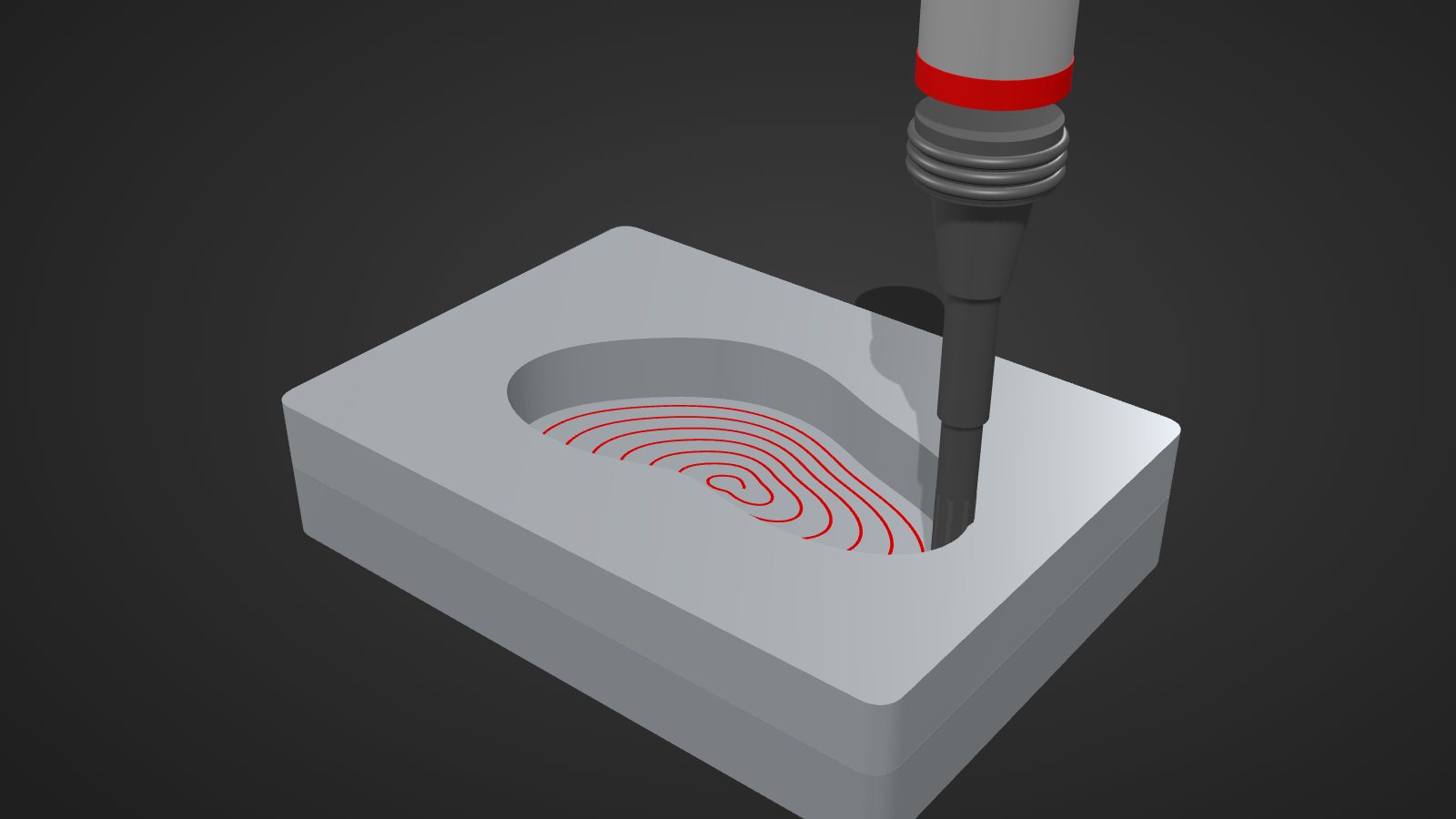
The problem with conventional offset toolpaths
With contour-parallel toolpaths, the programmed radial step is only correct on straight segments. On entry, when stepping between passes and in arcs, the actual radial depth of cut increases. The patent gives an example: on a straight line the cutter contacts 58° of material, in an arc 72°. At the same feed, that is about 31% more material removal, and that is exactly where tools break.
Method 1: transition areas (US 8,295,972)
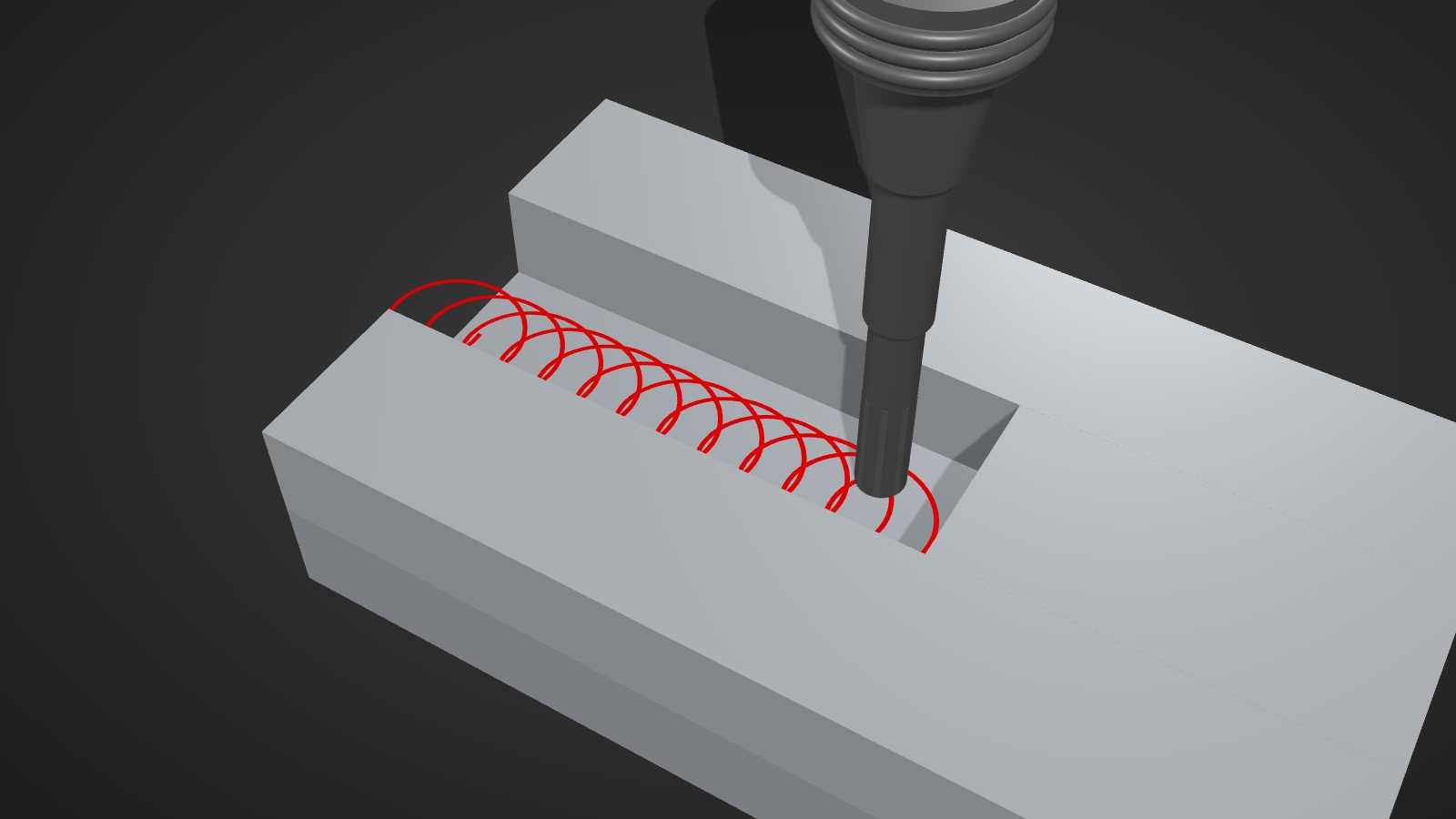
The starting point is the usual offset toolpath. The method finds the problem areas and places transition areas there: strips with round ends that are cleared first, for example with a ramp or as a slot along the medial axis of the pocket.
- The normal cuts are trimmed where they meet the transition areas.
- The pieces are joined by connecting moves that lie almost entirely inside the already cleared transition area. According to the claim, the tool is "substantially disengaged" there.
- The connections are S-shaped, made of two tangent arcs. The tool keeps moving without sharp changes of direction.
Where the depth of cut still increases, it is compensated, either with several axial passes or with a lower feed. The patent works through an example: if the radial depth rises from 25% to 100%, the slot is cut in four steps at 25, 50, 75 and 100% of the depth. For a 25% increase in depth, a 25% lower feed is enough.
Method 2: non-concentric arcs (US 9,946,245)
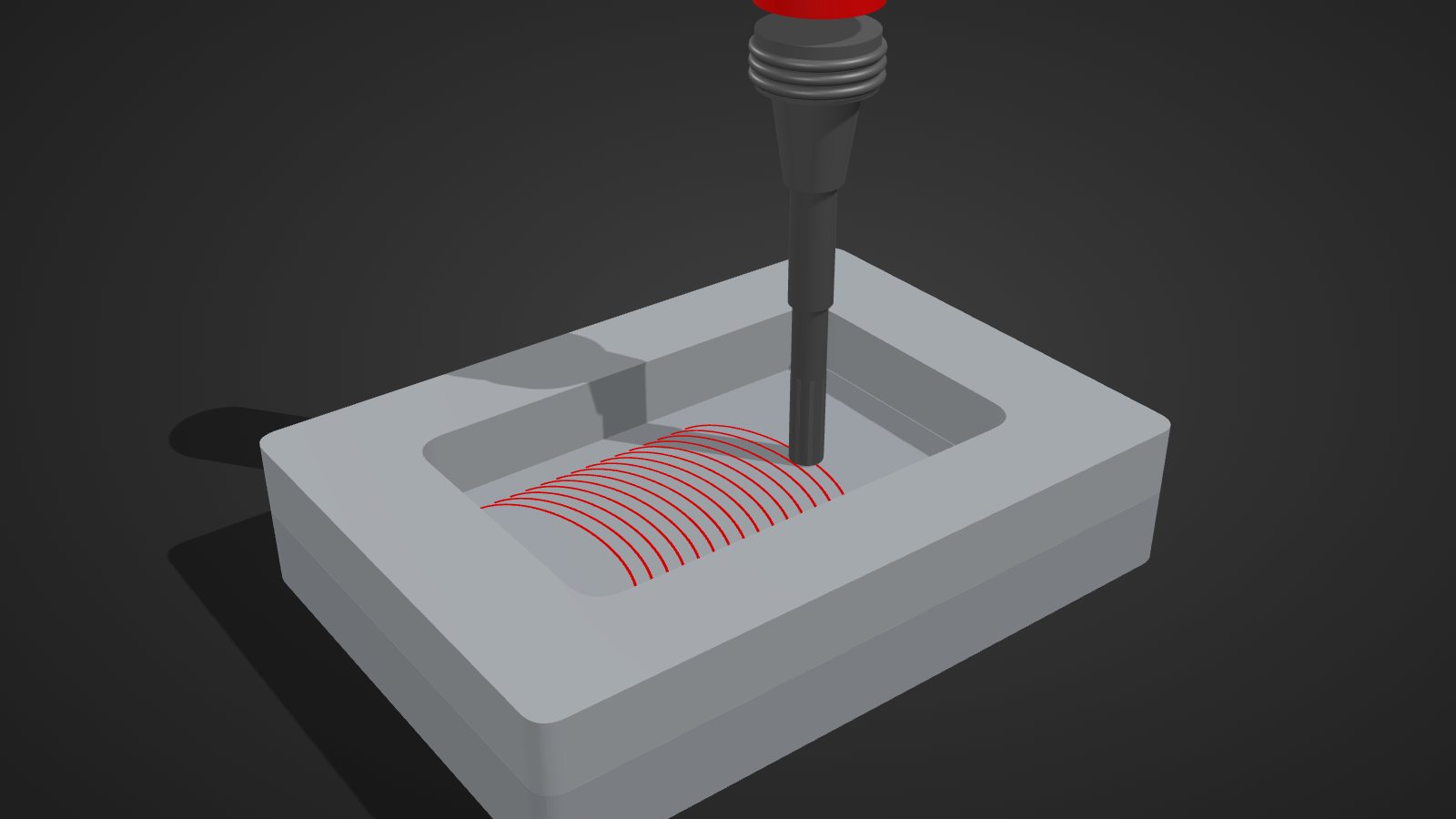
With normal offsets, the arcs of successive passes are concentric, and engagement rises in every arc. Celeritive uses non-concentric arcs: the arcs start earlier, and the spacing between passes grows from inside to outside. In the patent example it grows from about 3.12 mm to 3.59 mm. In one variant an arc is replaced by a line-arc-line sequence.
According to the patent, this reduces material removal rate, tool load and chip thickness in the arcs. That improves chip evacuation, heat dissipation and tool life and allows more aggressive cutting parameters.
The calculation: the Voronoi diagram
Claim 1 of this patent describes the calculation: first the Voronoi diagram of the region to be machined is computed. It divides the area by which contour segment is nearest and contains the medial axis of the pocket. Then additional branches are added (modified diagram), and the resulting faces are traversed to create the toolpath segments.
iMachining and VoluMill compared
| iMachining (SolidCAM) | VoluMill (Celeritive / ModuleWorks) | |
|---|---|---|
| Controlled variable | engagement angle between minimum and maximum | actual radial depth of cut, removal rate |
| Main toolpath | morphing spiral | offset-based paths with transition areas and non-concentric arcs |
| Islands, bottlenecks | moats, separating channels, trochoidal-like leftovers | transition areas, e.g. slot along the medial axis |
| Cutting data | Technology Wizard per toolpath point | feed reduction or axial sub-passes |
| Patents (selection) | EP 2 681 683 (priority 2011) | US 8,295,972 (priority 2008), US 9,946,245 (priority 2011) |
Patents and context
The patents mentioned are US patents of Celeritive Technologies, Inc.: US 8,295,972 "High performance milling" (priority October 2008) and US 9,946,245 "Non-concentric milling" (priority July 2011). The family includes further patents. Terms and territories were not legally reviewed here. VoluMill is designed to be platform-independent, i.e. for integration into different CAM systems.
Frequently asked questions
What is the main difference from iMachining?
iMachining controls the engagement angle and builds the toolpath as a morphing spiral. VoluMill controls the actual depth of cut and therefore the removal rate, and works with transition areas and non-concentric arcs.
Who owns VoluMill today?
VoluMill was developed by Celeritive Technologies. ModuleWorks acquired Celeritive in 2024.
May I program similar toolpaths?
General principles such as offsets, trochoids or feed adaptation are well-known prior art. The specific methods are protected. For your own software, a review by a patent attorney makes sense. This article is not legal advice.