What is trochoidal milling?
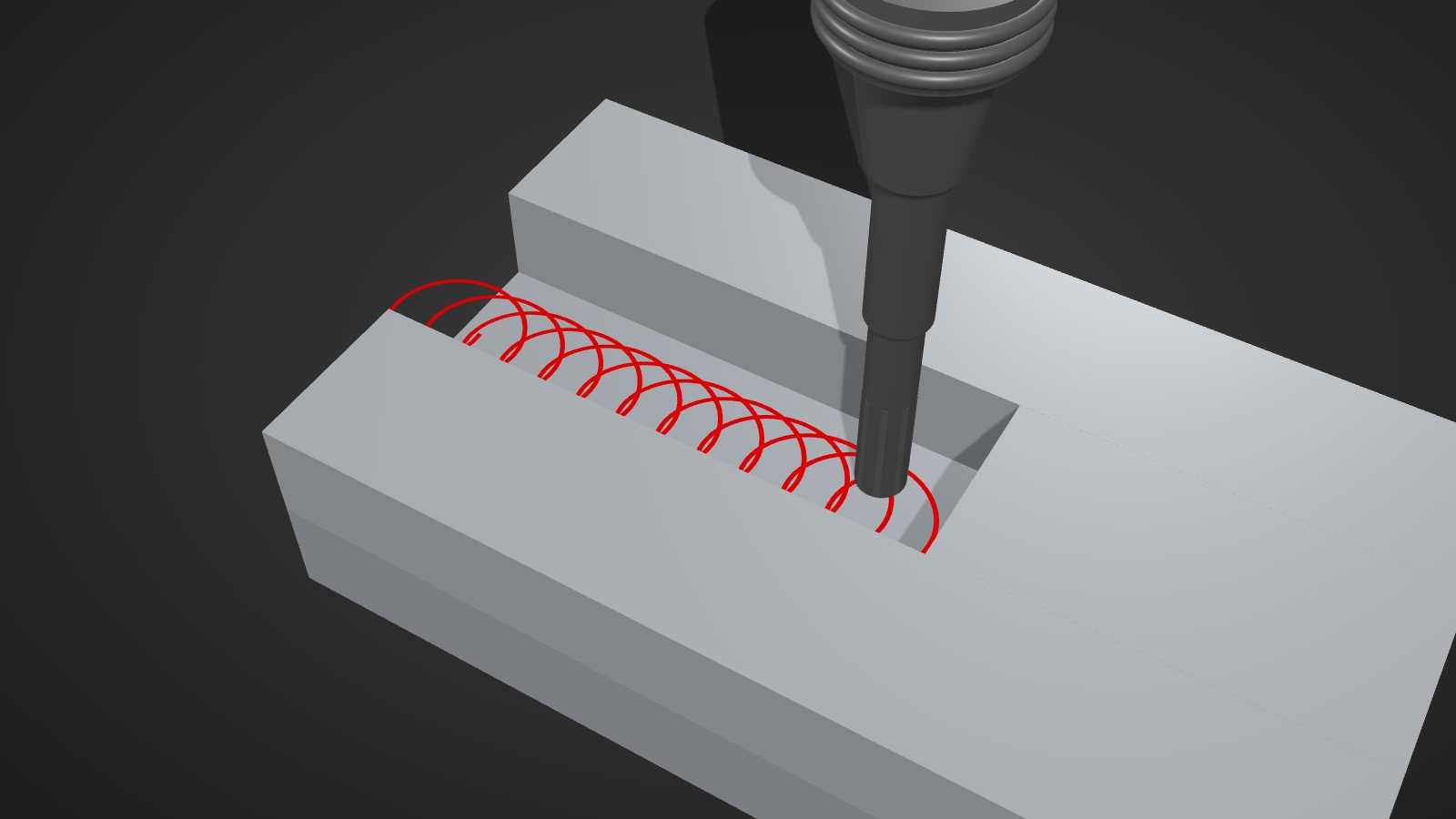
In trochoidal milling the cutter superimposes a circular or looping motion on its feed. Instead of cutting a slot at full width, the tool peels the material away in many narrow passes. The name comes from the trochoid, the curve traced by a point on a rolling circle.
Modern CAM systems take the idea further: toolpaths are calculated so that the tool engagement angle stays as constant as possible, even in corners and tight areas. This is why it is also called dynamic or engagement-controlled milling. In hyperMILL, for example, it is part of MAXX Machining.
The principle: small ae, large ap
Conventional roughing uses a large radial step (ae) and a small depth of cut (ap). Trochoidal milling turns this around:
- Small radial engagement ae: a fraction of the diameter depending on material and tool, at the lower end in tough materials.
- Large axial depth ap: often two to four times the diameter, i.e. almost the full flute length.
- Higher cutting speed and feed: possible because each edge is only briefly engaged and has time to cool.
Benefits in practice
- Constant tool load: no load peaks in corners, fewer broken tools, smoother running.
- Even wear: the whole flute length is used instead of just the bottom few millimetres.
- Less heat in the part: most of the heat leaves with the chip.
- Shorter machining times: trade publications report savings of up to 60%, depending on the part and the starting point.
- One tool for more: slots of different widths, pockets and contours can be machined with one cutter.
When does trochoidal milling pay off?
The strategy is particularly strong in difficult materials such as stainless steel, titanium, nickel-based alloys and hardened steel. It also shines when roughing deep pockets and slots and on thin-walled parts, because lateral forces stay low.
It makes less sense on very flat parts with little depth of cut or on machines with limited dynamics. There, the large share of air moves brings no advantage.
Machine and tool requirements
- Machine dynamics: many short path segments need a control with good look-ahead and suitable acceleration settings.
- Tool: long flutes, 4 to 5 teeth, variable helix and chip breakers help against chatter and long chips.
- Holder: hydraulic or shrink-fit chucks with good runout so that all teeth carry the load evenly.
- Chip evacuation: in deep slots, use air or coolant deliberately so chips are not recut.
What matters in CAM programming
Most of the gain is made in programming. Key factors are a realistic stock model to avoid air cutting, sensible retracts, adapted cutting data and a simulation of the toolpaths with machine and fixture. A trochoidal program with the wrong cutting data gives away the advantage or overloads the machine.
| Conventional roughing | Trochoidal milling | |
|---|---|---|
| Radial engagement ae | large | small |
| Axial depth ap | small | large |
| Tool load | fluctuating, peaks in corners | almost constant |
| Flute length used | lower section | almost full length |
| Demand on the control | low | high (many short segments) |
Frequently asked questions
Is trochoidal milling the same as HPC or dynamic milling?
Not quite. HPC (high performance cutting) generally describes machining with a high metal removal rate. Trochoidal or dynamic milling is a toolpath strategy that often makes HPC reliable in the first place.
Do I need special cutters?
Existing HPC cutters often work. For maximum performance, tool makers recommend cutters with long flutes, chip breakers and variable pitch designed for small engagement.
Can any machine do trochoidal milling?
In principle, yes. How much time you gain depends on the dynamics of the machine and control. On older machines it is worth matching the programs to the feed rates the machine can actually reach.